
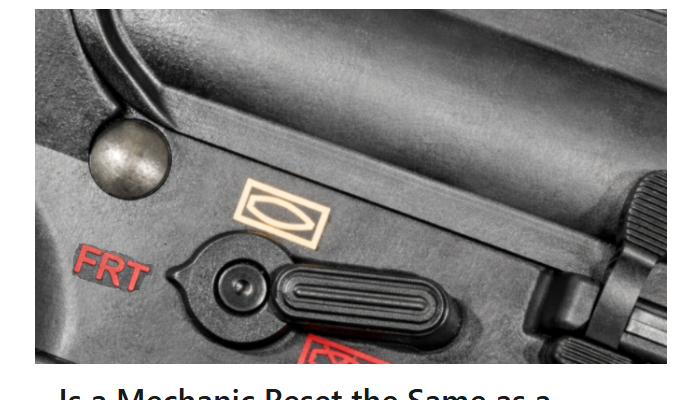
In May 2025, the United States Department of Justice (DOJ) announced it will no longer pursue federal enforcement actions against Forced Reset Triggers (FRTs), effectively settling litigation with the manufacturer, Rare Breed Triggers, and declining to classify the company's FRT-15 as a machine gun under federal law. This decision marked a significant shift in the federal enforcement posture and reopened a broader legal question: whether guns that use FRT systems, as a general category, fall within the statutory definition of a "machine gun."
The DOJ's position regarding the FRT-15 does not necessarily resolve the legality of other FRT designs, nor does it clarify whether future iterations or similar devices produced by other manufacturers would be treated differently under federal law. This uncertainty raises a central question for both firearm owners and regulators: are Forced Reset Triggers categorically lawful, or is legality contingent on specific mechanical design choices?
This article examines whether a gun's use of a Force Reset Trigger meets the statutory definition of a "machine gun" under federal law as defined in 26 U.S.C. § 5845(b), incorporated by 18 U.S.C. § 921(a)(23), and as authoritatively interpreted by the Bureau of Alcohol, Tobacco, Firearms and Explosives. The analysis will begin with a comparison of how traditional machine guns and FRTs function; then, provide an examination of applicable statutory language, relevant case law, administrative interpretation, and finally, an assessment on how these elements interact.
How Machine Guns and Forced Reset Triggers Work
Traditional machine guns, such as the Thompson submachine gun, or modern belt-fed systems like the M240 or M249, are designed to fire multiple rounds automatically with a single continuous trigger function. Once the trigger is depressed, the entire firing cycle continues by feeding, firing, extracting, and ejecting rounds until the trigger is released or the gunner is out of ammunition. The gunner's only input is limited to consistently maintaining this single instance of rearward pressure on the trigger; the firearm's internal mechanisms controls the firing cadence.
By contrast, the AR-15 platform is a gas-operated, semi-automatic firearm. In a standard configuration, each pull of the trigger releases the hammer, firing a single round. Gas redirected from the barrel cycles the bolt carrier group, ejects the spent casing, chambers a new round, and resets the hammer. However, the trigger itself must reset, requiring the shooter to release pressure and ride the trigger forward before another round can be fired.
A Forced Reset Trigger alters this interaction by using the rearward motion of the bolt carrier group to mechanically force the trigger forward after each shot. This design accelerates the trigger reset process and requires only that the shooter's finger re-engage the trigger before each subsequent discharge. Importantly, the firearm will not continue firing if the trigger is held fully to the rear; the trigger must reset and be actuated again through a separate application of finger pressure for each shot.
While FRT systems can enable rapid rates of fire under certain conditions, each discharge remains mechanically tied to a discrete trigger reset and actuation cycle. This distinction between continuous fire resulting from a single trigger function and rapid fire resulting from repeated trigger resets forms the foundation of the legal analysis that follows.
Statutory Definition and Textual Interpretation
Machine guns became subject to heightened regulation under the National Firearms Act (NFA) of 1934, which is where the definition comes from. Under 26 U.S.C. § 5845(b), a machine gun is:
Any weapon which shoots, is designed to shoot, or can be readily restored to shoot, automatically more than one shot, without manual reloading, by a single function of the trigger.
This definition is incorporated into the criminal provisions of the Gun Control Act (GCA) and through 18 U.S.C. § 921(a)(23), making its interpretation determinative for both regulatory classification and criminal liability. Although the statutory language appears straightforward at first glance, its application to modern fire-control technologies (FRT systems) and more antiquated bump stock technology, raises interpretive questions not expressly resolved by the text.
The statutory definition does not define the term "automatic" or "single function of the trigger," leaving their ambiguous meaning to the judiciary to interpret. As a result, courts construing § 5845(b) rely on everyday ordinary meaning, mechanical understanding, and traditional principles of statutory construction.
Judicial interpretations of "single function of the trigger" have distinguished between automatic fire, which allows multiple rounds to be discharged as a result of a single trigger pull, and semi-automatic fire, which requires the operator to pull the trigger once to discharge a single bullet. The key difference being that semi-automatic fire requires the trigger to be reset and re-engaged before each discharge.
These interpretations highlight the focal importance of the mechanism and function of the system, rather than the rate of fire as the primary determinant of automatic and semi-automatic classification. In fact, the statute has no reference to rate of fire and focuses solely on the relationship between trigger function and discharge meaning. The capability of rapid fire alone does not convert a firearm into a machine gun, absent continuous fire from one trigger pull.
The Bureau of Alcohol, Tobacco, Firearms and Explosives is responsible for administering the NFA and GCA, and issues interpretive guidance regarding firearm classifications. However, recent developments in administrative law confirm that courts do not defer to agency interpretations of criminal statutes simply because an agency is charged with enforcement. Agency guidance is considered only to the extent that it is sufficiently persuasive and consistent with statutory text. Courts retain final authority to interpret § 5845(b), and agency positions cannot expand criminal liability beyond what Congress has clearly defined.
Taken together, the governing rule requires that a weapon be classified as a machine gun only if it fires multiple rounds automatically, as a result of a single trigger function, as that term is understood through ordinary meaning, mechanical operation, and narrow construction of criminal statutes.
Recent Case Law & Judicial Interpretation
The most relevant judicial guidance for interpreting whether guns using Forced Reset Trigger systems qualify as machine guns comes from litigation concerning bump stocks. Although mechanically distinct, bump stocks represent the closest modern regulatory analogue because courts have already examined whether a device that enables rapid fire satisfies the statutory requirement that a firearm fire "automatically … by a single function of the trigger."
A bump stock is a device that harnesses recoil energy to allow a semi-automatic rifle to slide back and forth within the stock. As the firearm recoils, the trigger resets and then re-contacts a stationary finger, enabling rapid successive shots. Importantly, the trigger mechanically resets between each discharge, and the firearm will cease operation if the shooter stops applying trigger pressure. Like FRTs, bump stocks increase the rate of fire without altering the basic firing sequence of one round per trigger reset.
In Garland v. Cargill (2024), the Supreme Court considered whether a bump stock-equipped rifle constitutes a machine gun under 26 U.S.C. § 5845(b). The Court framed the issue as one of statutory interpretation, not functional equivalence or policy. It concluded that a bump stock does not cause a firearm to fire multiple rounds "automatically … by a single function of the trigger" because the trigger resets after each shot and each discharge remains mechanically tied to a separate trigger function.
The Court emphasized that the statute focuses on how a firearm fires rather than how fast it fires. Rate of fire, standing alone, was deemed insufficient to satisfy the statutory definition, absent continuous fire resulting from a single trigger engagement. The Court also rejected reliance on agency reinterpretation to expand criminal liability, reaffirming that statutory meaning must be derived from congressional statutory text, rather than regulatory policy.
The governing rule, emerging from Cargill, is that a firearm qualifies as a machine gun only when multiple rounds are discharged automatically, as the result of one trigger function, not merely because a device enables rapid, successive fire through repeated trigger resets.
Application of Cargill to Forced Reset Triggers Across Platforms
Applying the rule articulated in Garland v. Cargill to FRTs requires focusing on trigger mechanics rather than firing speed, manufacturer identity, or platform. The statutory inquiry remains whether a device causes a firearm to fire multiple rounds, automatically, as the result of a single function of the trigger.
Forced Reset Triggers–whether produced by Rare Breed Triggers, Active Safety Designs, or other manufacturers–share a common mechanical characteristic: the trigger resets between each shot and must be re-engaged for each discharge. Specifically, the firearm ceases firing if the trigger is not reset and actuated again. Under Cargill, this mechanical reset is legally significant because it preserves a one-shot-per-trigger-function firing sequence, even when the reset is mechanically-assisted.
This reasoning does not depend on the AR-15 platform at issue in earlier enforcement actions. If an FRT installed in another firearm–such as an MP5, JAKL, or other semi-automatic system–operates such that each round is discharged only after a single trigger reset and pull, the same statutory analysis applies. The statute does not distinguish by firearm type, manufacturer, or firing cadence.
Accordingly, Cargill suggests that the classification of FRTs must turn on objective mechanical operation, not on functional similarity to automatic fire, or federal agency characterization. While individual designs may vary and remain subject to fact-specific evaluation, the governing statutory rule applies uniformly across platforms and manufacturers at the federal level.
Conclusion
A gun using a Forced Trigger Reset system is not a machine gun under federal law. Under 26 U.S.C. § 5845(b), and as clarified by the Supreme Court in Garland v. Cargill, a firearm is only a machine gun if it fires multiple rounds, automatically, from a single pull of the trigger. Forced Reset Triggers do not act in such a way; instead, the trigger resets between shots and must be pulled again for each round, even if that reset is mechanically-assisted. This conclusion applies at the federal level only. States are free to regulate or prohibit FRTs under their own laws, and several are doing so, or considering it. As a result, while a Forced Reset Trigger does not convert a semi-automatic firearm into a machine gun under federal law, lawful ownership still depends on compliance with applicable state and local regulations.